The Story of the Town
The War and the Holocaust
From the Soviet entry in September 1939 to the liberation in June 1944
With the outbreak of the Second World War, life changed. The war began on September 1, 1939, when the Germans invaded Poland; and, as is known, Pabradė (Podbrodzie) was part of Poland.
Two weeks later, on September 17, 1939, the Soviets entered the town in the wake of the Molotov–Ribbentrop Pact. The Jews described the entry of the Red Army this way: “All night we heard the rumble of vehicles and the noise of an army passing through the town on its way to Vilna. We were afraid to go out and see what was happening; only in the morning did we see Russian tanks and soldiers, who did not treat us with hostility.” Eleven days later the Russians handed the Vilna region, including Pabradė, over to Lithuania. Half a year later, in June 1940, the Soviets invaded Lithuania and began to establish themselves there.
One of the memories of the Russian army is the smell of makhorka — the coarse tobacco, mixed with the roots of the tobacco plant, which the soldiers smoked as cigarettes rolled in newspaper, with spit for glue. They said that in Russia nothing was lacking and there was everything… yet they descended on the shops and, with rouble notes, bought whatever came to hand to send to their families in Russia. For example, Bartnisky’s shop had rubber shoes, which the Russians called “lacquer shoes”, and they bought up the entire stock. In the shop windows on Piłsudski Street there were nightgowns with muslin and lace, which the Russians were certain were ball gowns; they bought them and sent them to their wives. So it was too with watches and notebooks from the Charmatz family’s shop, and other goods. As said, they bought everything.
It should be noted that many of the town’s residents knew Russian from the time of the First World War. In that war the Germans were “all right” with the Jews and traded with them; for example, the Shapira family supplied them with meat. The Russians, on the other hand, are remembered badly for several cruel incidents, such as the break-in at the home of Golda Shapira — the mother of the Shapira sisters — and the killing of Grandfather Meir and four brothers: Hirshel, Leibel, Chaim and Yudel.
To understand the events that befell Pabradė from the outbreak of the war, some historical background is needed.
The Molotov–Ribbentrop Pact
In the early 1930s Stalin, the leader of the Soviet Union, adopted a moderate policy toward the West. The Soviet Union signed defence agreements with France and Czechoslovakia, and joined the League of Nations. From the mid-1930s Stalin sought to form a front against Germany and Italy, but the West hesitated to enter into an alliance with him. The Soviet Union feared Germany, since it recognised the Nazis’ fundamental hostility toward the Communist regime and their ambitions for territorial expansion in Eastern Europe. The policy of appeasement adopted by Britain and France in the face of German aggression convinced Stalin that the Western states were helpless before Hitler. The Soviet Union understood that it needed to reach an agreement with Germany, and thereby advance its own aims.
On August 23, 1939 the agreement known as the “Molotov–Ribbentrop Pact” was signed, named after the two foreign ministers who signed it. The pact contained a public non-aggression treaty and a secret protocol, which divided the East European space into a German sphere of influence and a Soviet sphere of influence.
About a week after the signing of the pact that divided Poland between the two powers, Germany invaded Poland and the Second World War broke out. The Soviet Union too invaded Poland from the east, in coordination with Germany. Poland had been established in 1919 as part of the Versailles agreements; the kingdom that had vanished from the map in the 18th century returned as a national republic. Neither nation had reconciled itself to its existence: Germany claimed that Poland’s existence had robbed it of its eastern provinces, and the Soviet Union refused to recognise that its western provinces had become part of Poland. And so Poland was divided between Germany and Russia, as laid down in the pact. The two states agreed that they would not attack one another, and would not cooperate with a third power that attacked either of them. This agreement was honoured for the first two years.
On September 1, 1939 large German forces crossed the Polish border. The SS staged a ridiculous border incident, which no one believed, that served as the pretext for the attack. For the first time the world witnessed modern warfare that used tanks and bombers. The Poles were not prepared for a war of this kind; they had no air force, and they had no tanks. They had cavalry. With rare courage, perhaps with foolishness, Polish cavalrymen charged the German tanks and armoured vehicles. Poland managed to hold out for 18 days. Its fall was swift and painful.
On September 17, 1939 the Soviet Union attacked Poland. A day later Poland surrendered and ceased to exist as a sovereign state. The Polish government managed to flee to Romania and became a government in exile. The western part of Poland was annexed to Germany, the eastern part was annexed to the Soviet Union — as agreed in the pact.
Fascism and Communism now had a common border.
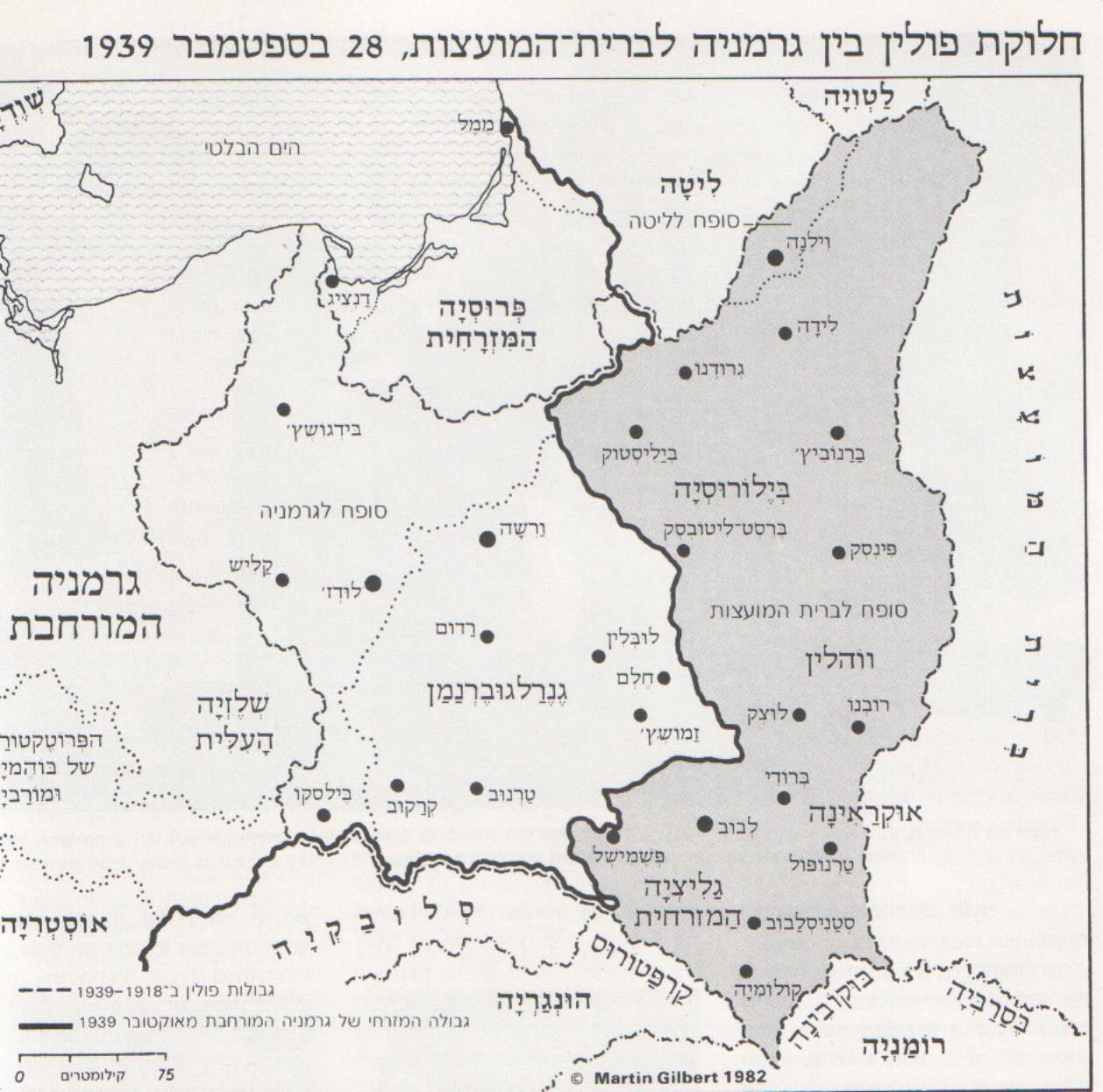
This historical background is important for understanding the events: why Pabradė passed from hand to hand for two years, until June 22, 1941.
From July 1940 Lithuania became a Soviet republic. The Soviet regime immediately enacted laws such as the nationalisation of shops and property, a ban on engaging in trade, a ban on teaching the Hebrew language — and so they began to study in Yiddish. The Zionist movements ceased to exist. Yet despite the new directives and the hardships, it can be said that life more or less returned to its course.
The Soviet press did not report on what was happening in the countries under Nazi occupation, and no propaganda was conducted against them. The only propaganda was anti-religious. In this period, the Jews remember, trains loaded with stones and equipment passed through Pabradė, and no one knew what they meant. Meanwhile refugees arrived who had managed to escape from the Warsaw area, such as the family of Hadassah Rosen/Shapira, whose father was a teacher at the Tarbut school and a beadle in the synagogue. They told of rumours that the Germans were setting up ghettos for Jews. It was hard to believe, and it occurred to no one that Jews would be murdered for no wrong they had done. The Soviet press continued in its customary silence, and gave away nothing about the relations and the agreement between it and Germany.
So life went on until June 22, 1941.
One morning the radio announced that Hitler had ordered his army to attack the Soviet Union.
Molotov announced that the Germans had crossed the border and the invasion of Russia had begun, in an operation that was given the name “Barbarossa”. In doing so Hitler violated the Molotov–Ribbentrop Pact that existed between the two states.
The next morning German aircraft appeared and began to bomb Vilna and its surroundings. Our Pabradė served as an important railway artery, and it too was bombed. Throughout the day everyone moved eastward. The trains had been paralysed, so the means of transport were carts, a few cars, and mostly people went on foot. Whoever could joined the Red Army, which was retreating in panic.
The turmoil was exploited by the Lithuanians, who came in with drawn knives shouting “Now we will slaughter the Zhids”. They began to loot, rob and kill. Shops were immediately forbidden to sell goods to Jews, and the Jews’ horses and machines were taken.
The first Jewish victims murdered by the Lithuanians and the Germans were: Idel Kolbak, Yosef and Avraham Liberman, the rabbi from Yanishok, Kopel Shklarovitz, Chaim Zak, the brothers David and Eliezer Mirsky. It was clear that this was only the beginning.
Before dawn, every day, they began taking Jews out and shooting them. We all began to grow accustomed to the horrifying idea that tomorrow we too would no longer be among the living.
One night they took 67 Jews, among them infants and women, to the edge of the town near the flour mill. There they ordered them to dig pits to serve as positions for anti-aircraft guns; when they had finished the work, they shot them. The Jews tried to fight back with stones and fists, but it was a lost battle.
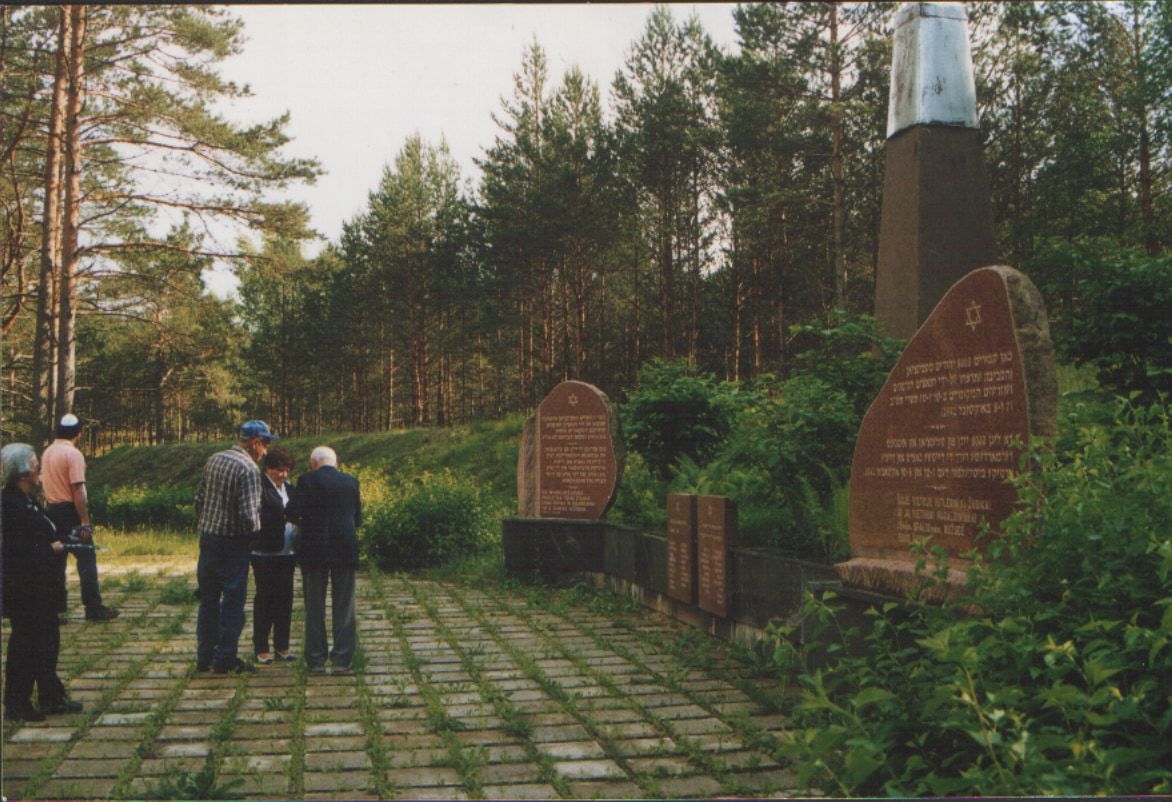
The oldest of those killed there was Israel Baruch Babersky, aged 72, and his family; the rebbetzin Etel Abramovitz and her sons Avraham and Leibke; Yitzhak Zilber, his wife and daughter; and many others. Ze’ev Abramovitz, the only one who managed to escape, told how the Jews fought for their lives with stones and sticks until they were killed. Years later a memorial was erected in Pabradė in their memory.
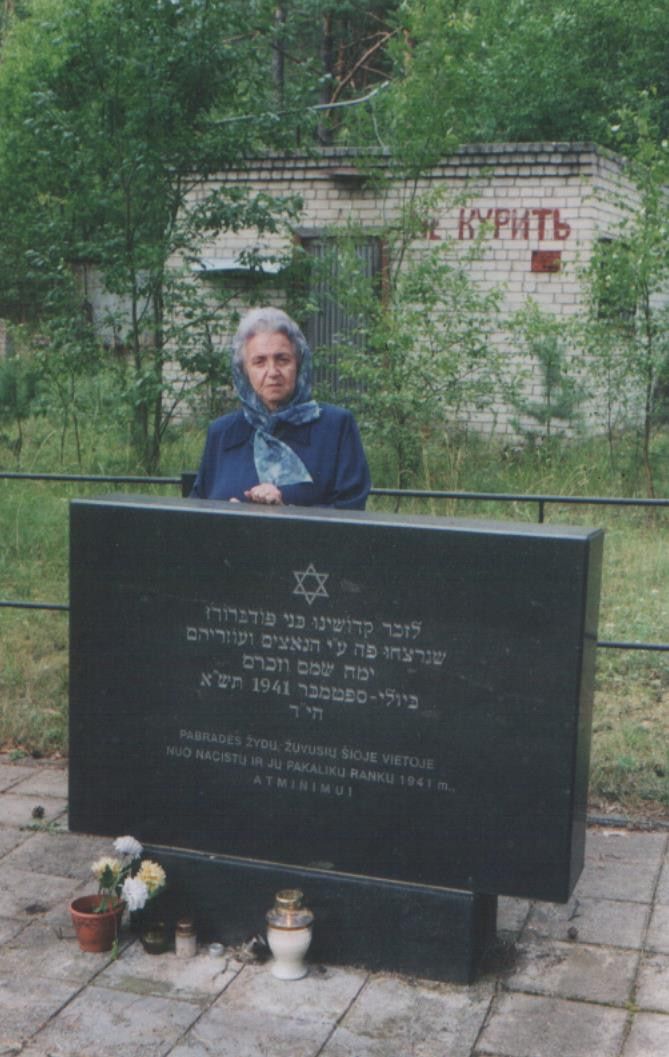
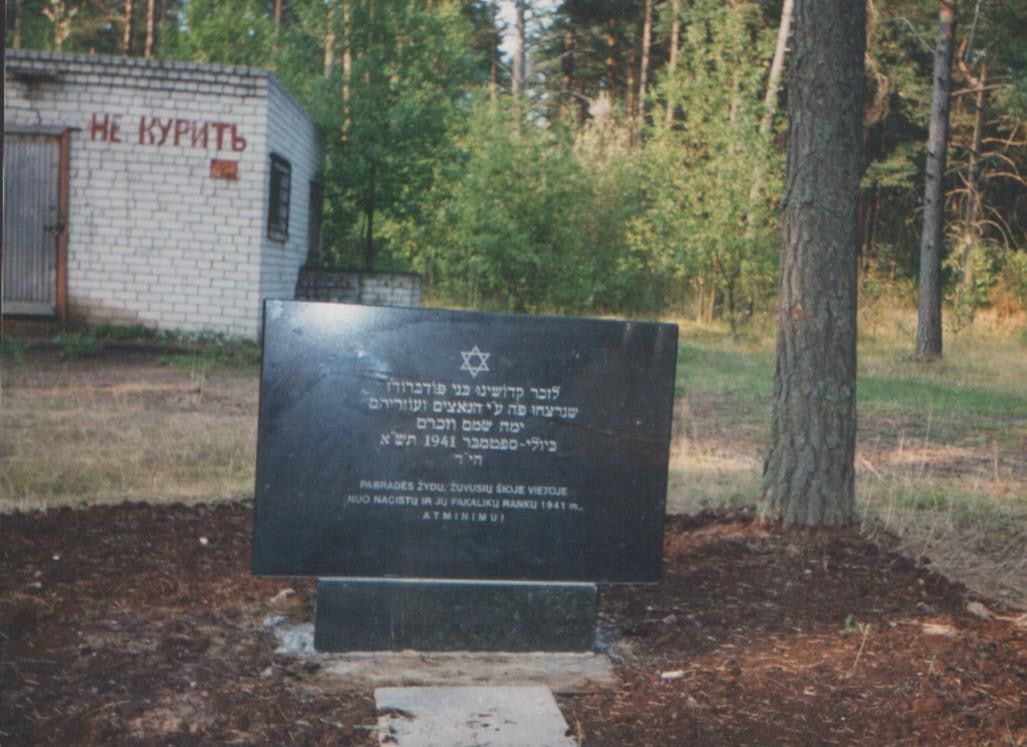
The memorial near the flour mill
The Ghetto
The prevailing situation — looting, robbery, pogroms and the chaos wrought by the Poles and the Lithuanians — continued until August 1941, the date of the Germans’ entry into the town.
Life changed. There were almost no Jews in the streets, the shutters of their homes were closed, the gentiles shouted abuse. Notices were posted throughout the town setting out the cruel decrees: denial of freedom of movement, a ban on walking in groups, the wearing of a yellow patch on the chest and on the back, a night curfew, a ban on dogs and Jews walking on the pavements — only in the drainage ditches between the pavement and the road — a ban on Hebrew studies. This was antisemitism “in all its glory”.
The Germans assembled the town’s Jewish notables and demanded that they hand over jewellery, furs, silver and gold. They began to arrest men and send them to labour camps; now and then they would shoot and kill for their own pleasure. A few days later they announced that all Jews aged 14–60 were obliged to go out to work, for without work there would be no food. Groups were taken out to jobs such as chopping wood, repairing roads and cleaning latrines in military camps.
The Jews were ordered to choose a Judenrat to represent them before the authorities. Its role was to carry out the Germans’ orders. Ben-Zion Wilian was chosen as chairman of the Judenrat; David Suzan — his deputy; Israel Bartnisky was the treasurer and Eliyahu Licht the secretary. There were also Nathan Shapira, Meir Blitz and Baruch Blushinsky. Everyone waited for instructions from the Germans on how to conduct themselves and what to do. And so it was told:
“Every morning a German representative came to the Judenrat, and after negotiating with us we sent workers with him, who went out in the morning and came back in the evening. The work was organised and orderly, unlike other towns, where there were rumours of Jews being snatched for labour.”
Shortly afterwards the Jews were required to move into the ghetto, which comprised two small streets in the centre of the town: Oranina and Bialski. The shock was great; the Jews did not understand what was about to happen. They were forced to leave their property and enter the small, crowded ghetto. The Poles who lived in the streets that became the ghetto moved into the homes of the town’s Jews. This order caused an uproar: the Poles wanted the finer and richer houses. At the same time, the Germans’ order forbade the Jews to take out furniture and property; only movable belongings that could be carried on one’s back were allowed. The Jews tried to save their property by digging pits in their yards and hiding valuables in them; some handed valuable property to gentile acquaintances for safekeeping, in the hope that one day they would be able to get it back.
The Judenrat had to organise and house every family. Life in the ghetto was hard, the overcrowding was terrible, the quantity of food was minimal; whoever could work, worked. Once a week a permit was given to go out to the market to buy food. The Jews gave valuables they had managed to bring with them in exchange for food.
The Lithuanians gleefully burned the magnificent library, which had been the pride of the town’s Jews. The heart ached at the sight of the flames. Smoke and soot covered the town. The Poles rejoiced and encouraged the acts of vandalism carried out by the Lithuanians.
Meanwhile rumours began to arrive of the murder of the Jews of the town of Molėtai, 50 km from Pabradė. This caused a shock among the Jews, because it was the first news that reached us of mass murder. It was clear that the liquidation of the ghetto was near. The holidays were approaching, the atmosphere was sad and the heart very heavy.
The members of the Judenrat tried to bribe the commander of the Lithuanian police with a gold watch, asking him to let them know when the Germans were due to liquidate the ghetto — when the Aktion would take place. The bribe did not help. The orders came directly from SS headquarters in Berlin. Persistent rumours circulated that special SS units were going from town to town murdering the Jews by shooting, or gathering them into synagogues and burning them.
We all understood that it was only a matter of time. It was no longer a question of whether it would happen — but when.
On the Friday before Rosh Hashanah 1941, about two weeks after the liquidation of the Nemenčinė ghetto, 25 km from the town, Wilian, the chairman of the Judenrat, announced that he had heard the ghetto was going to be liquidated. He suggested that anyone who could flee should do so; he himself fled with his family. And indeed, unusual movement of Lithuanians, forest wardens, police and many Poles was seen in the town. It was clear that something was about to happen. Flight to the forests began, but not everyone managed to escape. Rumour had it that the Jews were being transferred from Pabradė to Švenčionys, to a concentration camp. Most of the Jews did not believe the report.
Sabbath eve, 5 Tishrei 5702
On September 26, 1941, on the Sabbath eve, the Germans and the Lithuanians surrounded the ghetto, gathered the townspeople in the old synagogue, and the next day, on Sabbath morning, led them all in a convoy of carts, escorted by German soldiers, to Poligon, some 20 km away. There, in cold blood, they murdered 8,000 Jews from the towns of the Švenčionys district — including Pabradė.
Thus the glorious history of the town of Pabradė came to its end.
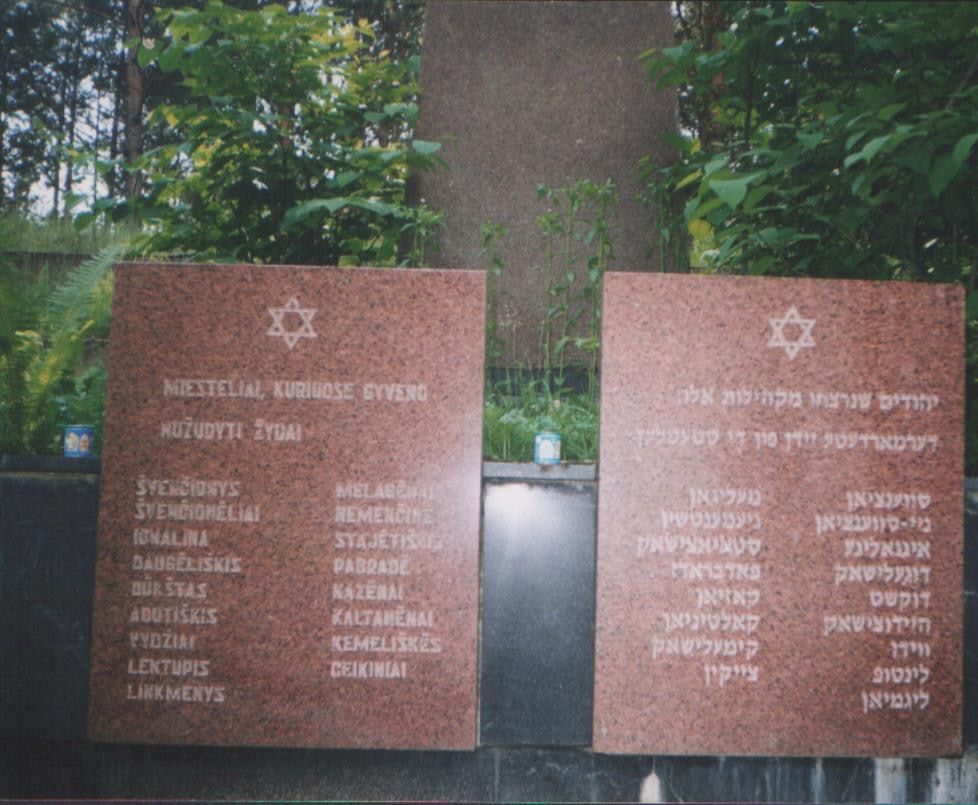
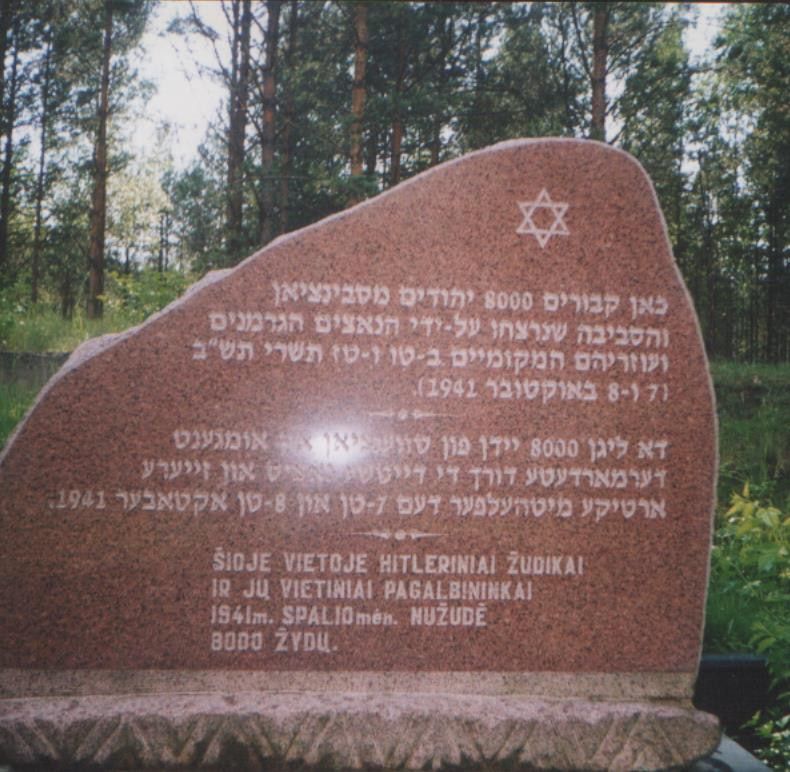
The memorials at Poligon
Those who managed to escape from Pabradė scattered in the forests and villages. A small number found shelter with Christian farmers; some reached the ghettos of Kemelishok, Michalishki and Svir — where the Aktionen had not yet begun. Several groups managed to reach the forest and join the partisans — the Nevsky brigade, the “Avengers” company, and the Jewish unit in the Markov brigade — such as Meir Biksen, Leizer Petshnik and the Shilon family.
For those who tried to reach Kemelishok, one more terrible thing happened on the way.
Baran
This is how Miriam Gavish-Glazer tells it:
Baran is a small village, not far from Kemelishok. We reached it a few days after the liquidation of the Pabradė ghetto; it was the beginning of October. The village is in Belarus, far from any main road, a godforsaken place. The Germans and their organised liquidations had not yet reached there. We stayed there about 3 months. The farmer with whom we hid was a gentile named Voisko, a greedy man; he agreed to build a double wall in the storehouse in exchange for payment in gold. We were 9 souls in the cramped hiding place.
In the village of Baran, in a small house, lived a Jew named Avraham, with his family of 6. He had almost no land, and he made his living from trade and from working for farmers in the area. He was a ritual slaughterer, an honest and kind-hearted man, loved by all. With the liquidation of the ghettos Jews came to him, and he took them in and shared with them the little bread and potatoes he had. When we reached Baran many Jews were already hiding with him.
One day, at the end of December 1941, Yona Levin arrived — the brother-in-law of my father, Israel Bartnisky — and just then the farmer’s wife came into her house and shouted: “Germans in the village!” Without thinking we ran to our hiding place. Yona Levin leapt from the house toward the forest, and the Germans caught up with him. We heard bursts of gunfire, and single shots that went on for a long time. At night, many hours later, when quiet had settled, the mistress of the house opened the opening in the wall and told us that the Germans had murdered all the Jews who had been in Avraham’s house. Avraham was in the forest and was saved, but his wife and two daughters were murdered.
13 Jews from Pabradė were murdered, among them: Yona Levin; the physician Dr Moshe Rozewski and his family — his wife Sonia, his daughter Bella, his daughter-in-law Mina; the brothers Berl, Israel and Yosef Zak; and Ben-Zion Ingeltzin. Other Jews from the area were murdered there too. After the murder the Germans ordered the village headman to bury the Jews in a mass grave.
After the fall of the Iron Curtain Miriam travelled several times to the area of the village of Baran to look for the house in which they had hidden during that terrible event, but she did not find the village, which today lies in Belarus. Mulik Karol-Keren managed to find the place on one of his many trips. It turned out that the problem lay in the spelling of the village’s name, which is written Barani and not Baran.
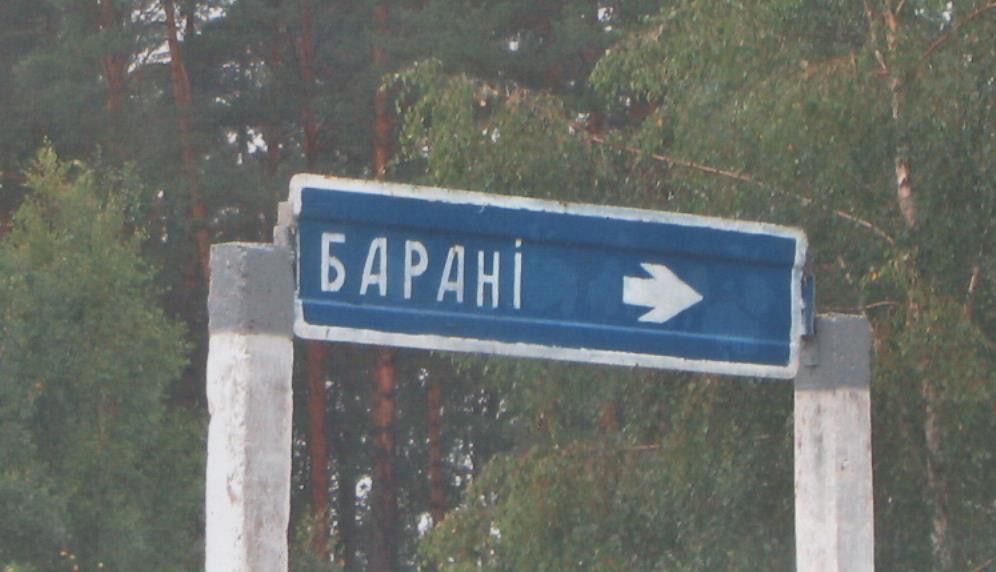
Once the place had been found, the community committee decided that a memorial had to be erected there in memory of the 13 people of Pabradė who were murdered, and that the story of the murder carried out at Baran had to be documented (the exact number of those murdered is not known). The project was by no means simple, but in the end two memorials were erected in memory of the murdered — one in Pabradė and one at Baran.
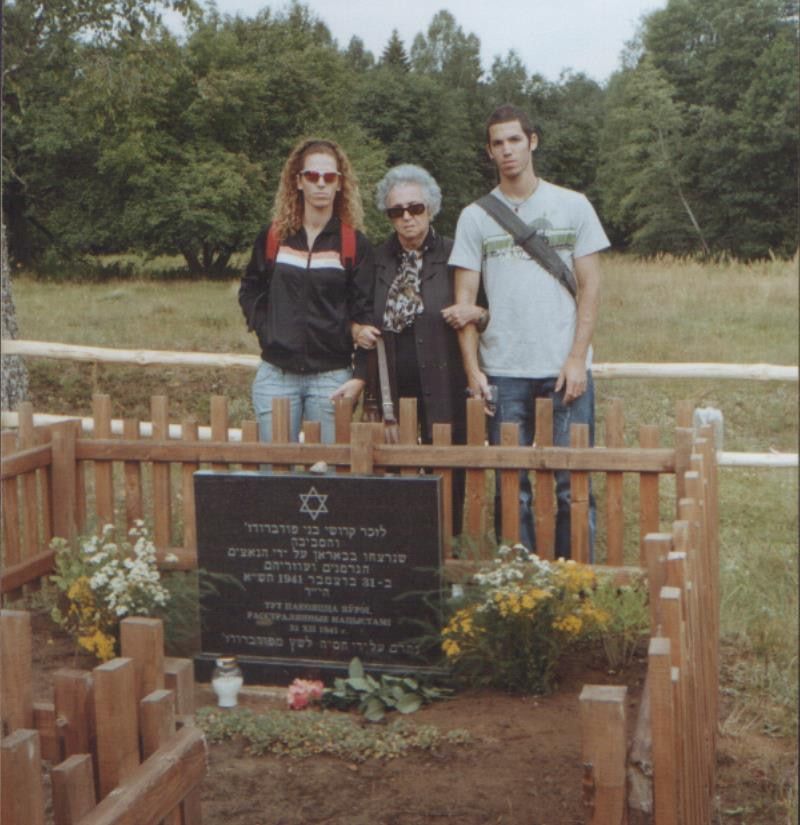
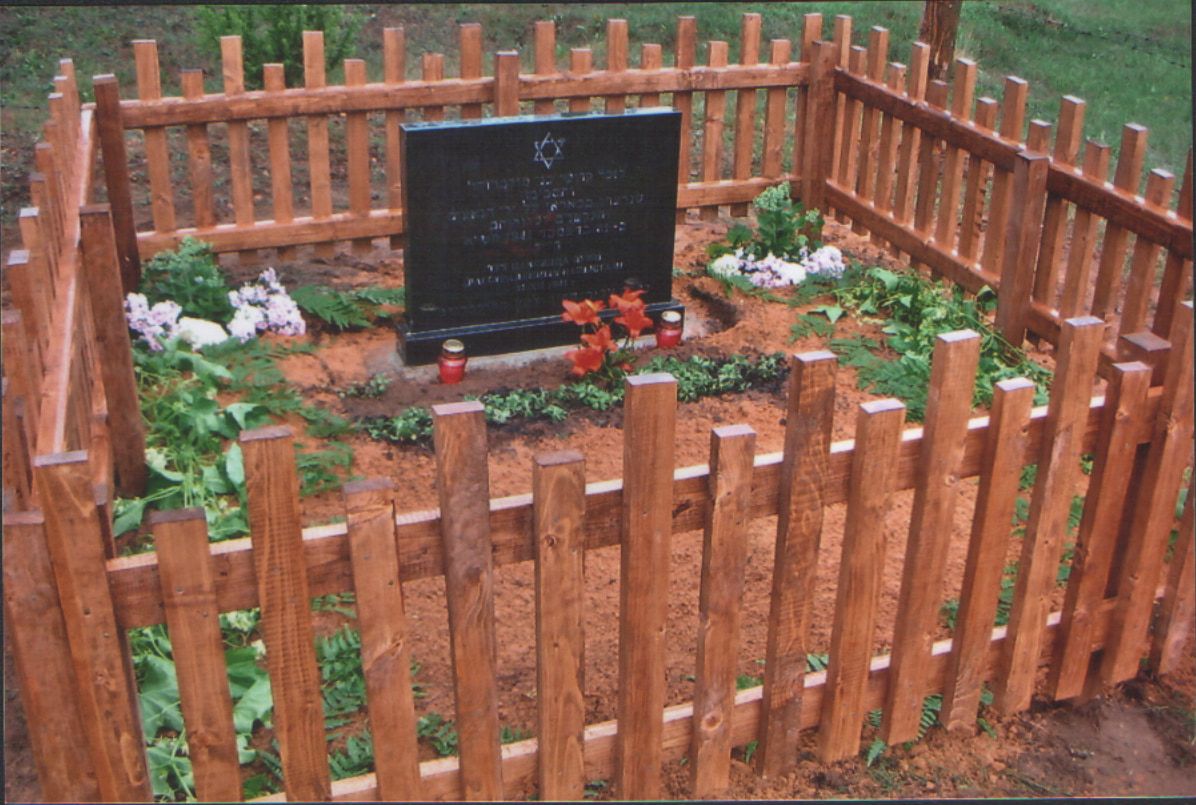
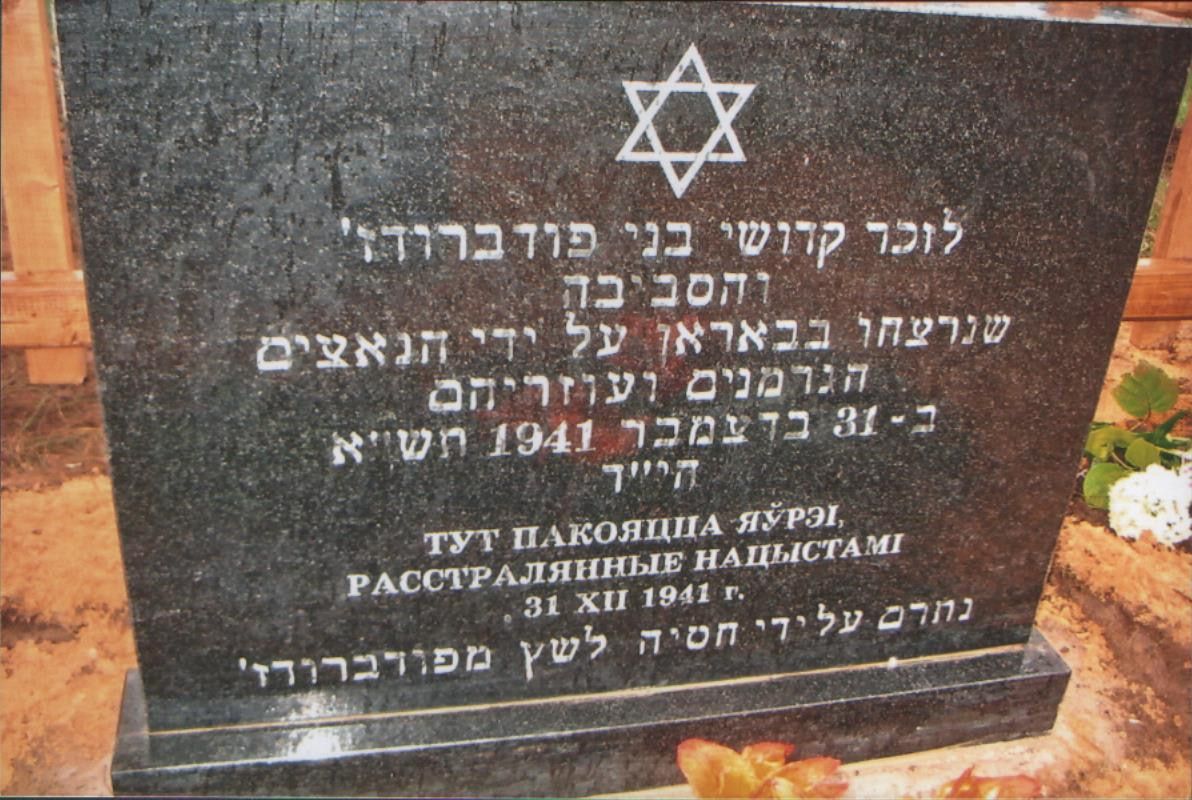
The memorial at Baran
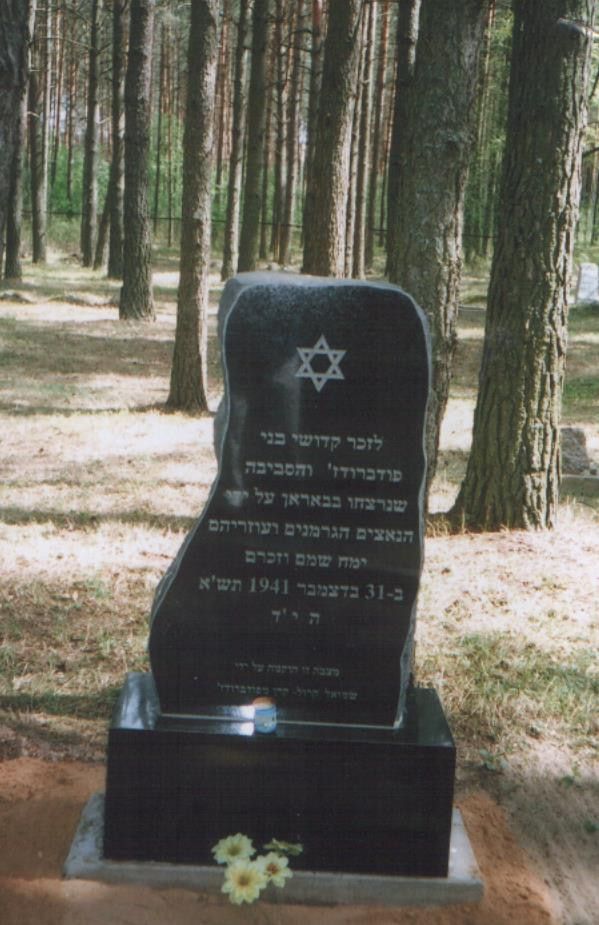
The Kemelishok Ghetto
Kemelishok lies about 50 km from Vilna, and 20 km from Pabradė. Today it belongs to Belarus.
The Jews of Pabradė reached the Kemelishok ghetto. The local Jews took in the people of Pabradė and helped them as much as they could. At first the ghetto was not fenced, and one could go in and out; at a later stage the area was fenced off, and the ghetto became closed and guarded. Pini Karol, Mulik’s father, was in charge of the ghetto.
The conditions were dreadful. The overcrowding, the struggle with hunger, the cold and the diseases were unbearable. Daily heroism was needed not to lose one’s human image. Wednesday was market day, and one was allowed out for two hours to buy food. The young people worked mainly at felling trees for the Germans.
The situation in the ghetto grew worse and worse. There was nowhere to go, and it was impossible to escape. There were rumours of pits being dug and of liquidation, but the people were helpless and could do nothing. About 10 months passed from the arrival of the Jews of Pabradė until the liquidation of the ghetto.
Sabbath, 13 Cheshvan 5703
On the Sabbath, October 24, 1942, 13 Cheshvan 5703, SS companies came with Lithuanians and Ukrainians, surrounded the ghetto, took all the Jews out to the forest and shot them in cold blood. The operation was sudden; only a few managed to escape and survive.
About 350 of the Jews of the Kemelishok ghetto, from Pabradė and the neighbouring towns, were buried in a mass grave. A priest who witnessed the atrocity placed a first marker on the mass grave and wrote on it: “Here lie buried 350 Jews from the Kemelishok ghetto.” Thanks to him, the place of their burial became known.
Chasia Marinov/Leshetz was in contact with the priest, and she remembered the place. Afterwards Mulik Karol came and erected the first memorial. As said, the site is in Belarus, inside a kolkhoz — agricultural land — and so the task of erecting the memorial was not simple. It took initiative, connections, bribes and a large financial investment to fence the site, erect a memorial and see to the paving of an access path. With the help of people “obsessed with the cause” such as Mulik Karol/Keren, Miriam Gavish-Glazer, Fima and Shlomo Petshnik, Meir Bikson, Mula Gilansky and others, a memorial was built, inscribed in Hebrew — to be a monument and a remembrance and a testimony that we will never forget our dead.
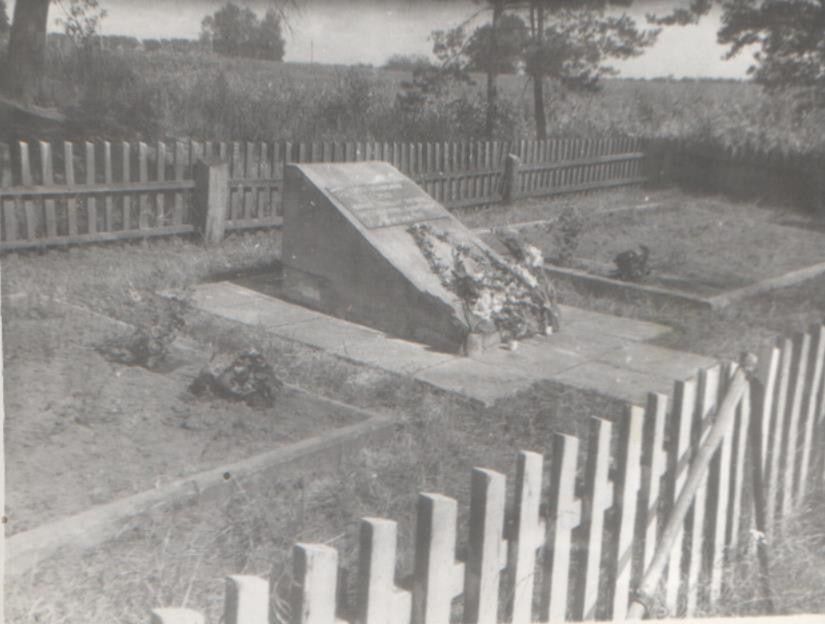
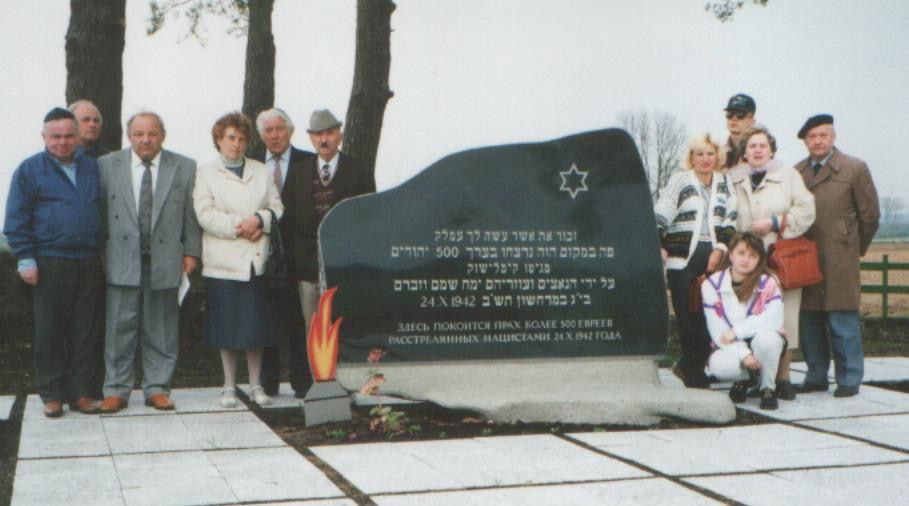
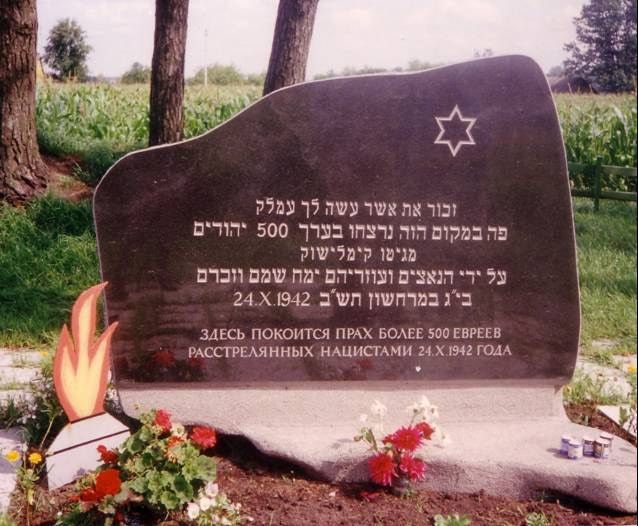
The memorial at Kemelishok today
Since 1944, every year on 13 Cheshvan, the people of Pabradė and their descendants have gathered for a memorial gathering.
Next annual memorial
13 Cheshvan 5787
Holon New Cemetery, Israel
The few Jews who fled and survived the liquidation of the Kemelishok ghetto reached the ghettos of Michalishki and Svir, but the Nazis and their helpers reached there too, and their liquidation was not long in coming.
The stories of how a small number of the people of Pabradė were rescued are remarkable. Some managed to cross into Russia, some wandered and hid in the forests, some found shelter with good gentiles.
We remember with gratitude the help of the gentiles who saved some of us. Most of us keep in touch with the gentile families, and see to it that they are repaid with support and financial help, and with the award of the title of Righteous Among the Nations. Families that have remained in contact with the gentiles are: the Petshnik family, the Licht family, Mulik Karol/Keren, the Gavish-Glazer family, the Feller family and others.
The longed-for liberation came with the arrival of the Soviets in June 1944. We saw Russian tanks and soldiers with the Russian flag. How good it was to see them. It was hard to grasp and to believe that liberation had really come and the war was over. The survivors began to return to the town, little by little.
The town was different. Some of the houses had been destroyed, and some had been taken over as dwellings by Lithuanians and Poles. Not one of the town’s residents was glad to see us, the survivors. Fortunately we received help from the Lithuanian Division, which had many Jewish soldiers and officers.
How sad it was to come back and see the town without Jews. It was no longer our wonderful, splendid town. It was no longer our home.