Testimonies & Stories
"Operation Kemelishok"
Eilat Katz (née Glazer/Gavish)
A roots journey, 1996
Translated from Hebrew. The original follows.
Normal children learn to say words like mother, father, home, grandma, grandpa when they are small. In my childhood I drank in words like: mother, father, Holocaust. I did not know what a grandma or a grandpa was.
Already as a girl I knew the map of Europe — I could point to where Poland was, where Lithuania was and where Germany was. I was raised on a number of truths and facts that were beyond dispute: “the German oppressors, may their name and memory be blotted out”, “the Lithuanians and the Ukrainians were collaborators”, “nothing German will ever enter our home”.
From 1991 — the collapse of the Soviet Union and the lifting of the Iron Curtain — my mother travelled to Lithuania every year, to the cemeteries, to the gravestones, to light a memorial candle, to weep and to mourn.
In 1996 we decided to go on a roots journey. The nuclear family organised for it: my mother and father, in their seventies, my elder brother and I, around fifty, and my younger sister, in her forties. The plan was to travel to Poland, where my father grew up, and to Lithuania, where my mother grew up. It was clear that we were in for a hard emotional journey, mostly of communing at cemeteries and lighting memorial candles, and visits to extermination camps.
After the journey through Poland, which was a powerful experience, we moved on to Lithuania. We toured Vilnius, mainly its Jewish side, Kaunas and its Jewish sites, and also lovely Trakai, with its lakes and its medieval castle. But the most important goal of all was to reach Kemelishok, to light memorial candles and say Kaddish at the mass grave where dozens of members of our family are buried. That is what I want to tell you about. To do so I will take you back in time.
Kemelishok, 1942
According to the records, in 1939 there were 140 families in Kemelishok, 36 of them Jewish. It is a remote little town, which the Germans reached relatively late, so its ghetto took in refugees from the surrounding area who had fled their own towns when the ghettos there were liquidated. Refugees came from the Pabradė (Podbrodzie) ghetto as well, among them many of our relatives: my mother’s father, a sister, brothers, a brother-in-law, uncles and cousins.
Conditions in the ghetto were horrifying: the overcrowding was dreadful — hunger, lice, disease and sores. The young were taken out to work, and only the old and the children remained in the ghetto. My mother worked at a dairy outside the ghetto; her brother and uncle were sent to labour camps.
On 24 October 1942 the Germans and their Lithuanian collaborators surrounded the ghetto, took out some 350 Jews (the exact number is not known), my relatives among them, and marched them to the forest about 3 kilometres from the ghetto. Pits had been prepared there; they were told to undress, and were shot in cold blood. All this my mother and her brother learned from Christian eyewitnesses. A priest who lived nearby set a simple stone over the mass grave and wrote: “In this place are buried some 350 Jews from the Kemelishok ghetto.”
The Family That Saved Her
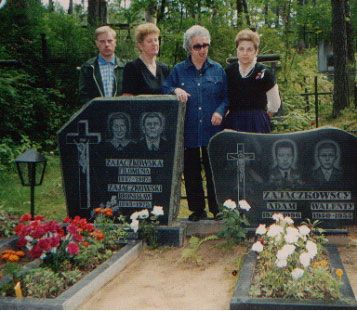
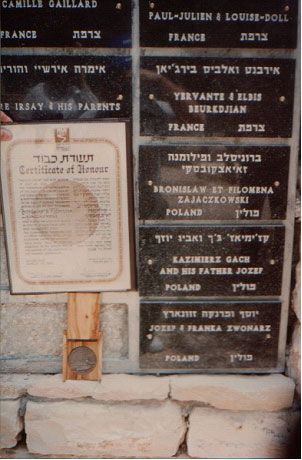
After her family was murdered my mother wandered among the villages, a girl of 17, alone; for part of the time she was with her brother Ze’ev Bartnisky and her uncle Reuven Licht. In a desperate search for a place to hide, she came to the home of Bronisław and Filomena Zajączkowski, a Christian family with three children: Adam, aged 10, Wanda, aged 4, and the baby Jadwiga. They hid my mother for several fateful months — not for money, but out of a belief in human life. My mother believes they saved her life. The family that saved her became our family.
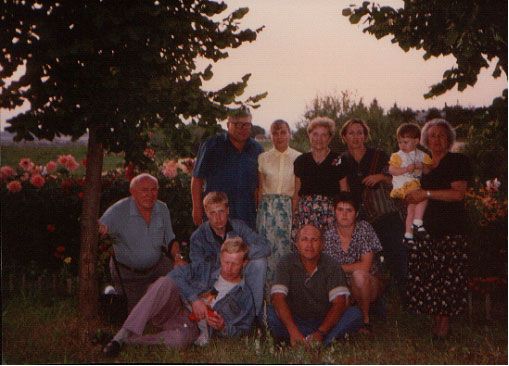
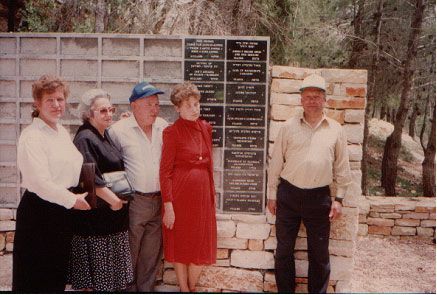
My mother corresponded with the Christian family from the 1950s. We helped them with parcels of clothing and money. The parents, Bronisław and Filomena, passed away; the connection with the children, now grown, continued. From 1991, with the opening of the borders, meetings began with “our gentile family” in Lithuania and in Israel, where they came several times with our help. The three children — Wanda, Jadwiga and Adam — came to a moving ceremony at Yad Vashem at which their parents were recognised as Righteous Among the Nations.
The Operation
When we arrived in Lithuania, in Vilnius, in 1996, on our roots journey, we began to find out how we could get across to Kemelishok, which is in Belarus. It turned out that we needed visas, and that getting them at the embassy takes some 4–5 days. We did not have much time, and it was clear that we would not go back to Israel without reaching our family’s most important gravestone, at Kemelishok, come what may.
And so we found ourselves in an absurd situation, sitting in the home of “our Christian family” — Wanda, her husband and her sons — and raising all sorts of possibilities for getting to Kemelishok. Zhenya, Wanda’s husband, a school principal, a big man, blond like the rest of the family, took out a map and began to explain to us what we came to call “Operation Kemelishok”. He showed us the border on the map, and explained that there are no fences. There are a few border posts on the roads, where soldiers stand and check the cars going through. The nearest stretch of border runs through a forest, where a stream flows that can be crossed. Zhenya summed up: one can get from Lithuania into Belarus fairly easily.
It was decided that the next day Zhenya and his son Alik would drive us in two Škodas to the forest, then continue to the border post, cross into Belarus and wait for us at an agreed spot. Wanda would go into the forest with us and lead us to meet the cars. From there — a short drive of about a quarter of an hour to the gravestone. The operation was supposed to take two hours.
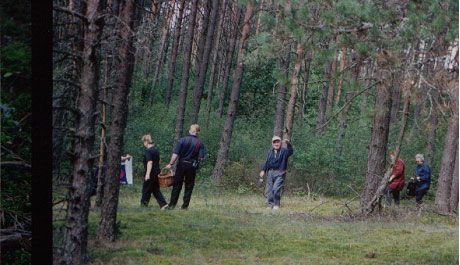
In the morning we got up, and there was tension in the air; we were fairly worried about what lay ahead. Zhenya and Alik got the cars ready. They bought bottles of vodka (just in case), so there would be something to give the soldiers at the border if need be. Wanda took wicker baskets. We drove in silence, each of us sunk in thought. We reached the forest and got out with Wanda. Zhenya reassured us: “Everything will be fine.” We went into the forest. Wanda gave each of us a basket — we had become berry-pickers. We were asked to keep quiet, or to speak very softly. Wanda showed us which berries to pick: there were small wild strawberries, raspberries, forest berries and blueberries.
We went into a forest out of a fairy tale; it would be easy to get lost in it. Around us were tall trees, conifers and green deciduous trees, with climbers and small bushes between them; all kinds of mushrooms, including red ones with white spots. One could feel how the fairy tales of forests and dwarves were born (the dwarves were not at home). My younger sister was afraid, and was not ashamed to say so: “What will we do if they catch us? They don’t speak English, this is not a democratic country, they could put us in prison.” My brother and I were just as afraid as she was, but we did not show it.
Listen, children! Father and I have been through the worst of all. We are not afraid. What can they possibly do?
At worst we would bribe them with dollars, which they would be glad to take, given their dismal economic situation.
Wanda hushed us; it was best that we not stand out. There were people around picking berries. After an hour’s walk in the forest we came to a stream bed that recalled the Jordan at its narrow places, and looked for somewhere to cross. We came to a place where there had once been a bridge and a flour mill, both of which had collapsed or been destroyed. There were big stones in the water, and it was possible to hop across them to the other side. We looked for sticks for Mother and Father, and crossed the stream.
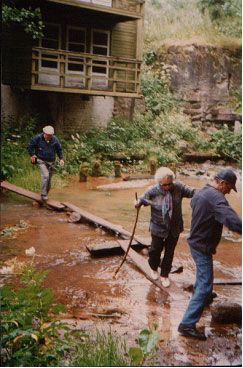
My sister and I were afraid that this story would not end well, that we would be caught. My “hero” brother promised us that nothing would happen. That did not calm me, because although the weather was pleasant, I was sweating. After some more walking we saw the road in the distance. Wanda went to see whether the cars had reached the meeting point. According to the timetable, Zhenya and Alik should already have been waiting for us. But the cars were not there.
Wanda moved us away from the road, so as not to arouse suspicion, since we did not exactly blend into the local scenery. We waited about 15 minutes that felt like an eternity. We worried that something had happened. We whispered quietly… When Wanda came back, she told us that one of the cars had broken down, and they had been delayed fixing it. She added that Zhenya had indeed given the soldiers vodka, and had made sure they would be at the border post on our way back. He and the soldiers had become “good friends”.
The cars arrived and we got in. We were in Belarus. On the way we passed through villages, and it felt like going back 50 years in a time machine: the dwellings and living conditions, the tools, the poverty and simplicity, and the general look of the villages. Around the houses they grew subsistence crops: a row of every kind of vegetable — corn, tomatoes, cabbage… Chickens wandered in the yards, goats for milk, and pigs.
After a quarter of an hour’s drive we reached the gravestone.
The Mass Grave
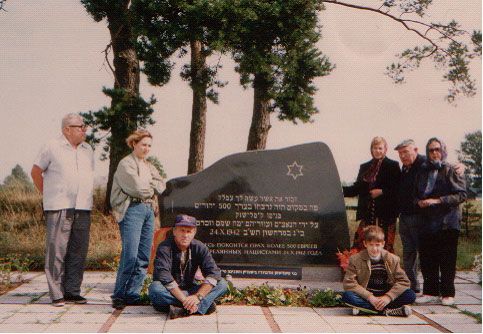
A path through farmland, a small fenced plot, and a black stone inscribed in Russian, Hebrew and Yiddish.
It was a paradoxical sight: in the middle of farmland, in a distant country, in a godforsaken place, a grave and a stone, which we — a Jewish family — had reached with the help of a Christian family, a bond that began in the Holocaust. In this place we connected to our roots and to our very existence.
A shudder passed through us; we stopped breathing. The past enveloped us on every side. It was a holy moment.
We lit memorial candles, said Kaddish, stood and stood and could not tear ourselves away. It was so hard for my mother, as if what was happening now had happened yesterday, and not 54 years ago.
After a long hour of silence we drove away. We were bound together by a feeling of pain, understanding, identification and empathy. “Operation Kemelishok” had been crowned with success.
My parents went to Wanda’s house, and we went back to the hotel. We sat in the room, my brother, my sister and I, in a foreign city, and wept — tears of relief, pain, release, sorrow and loss. So many feelings flooded us. Afterwards we laughed like mad at the way “Operation Kemelishok” had been carried out. The next day we flew home, feeling that we were a family far more united, loving, supportive and understanding.
Thirteen years have passed since that journey together; for us it was an experience never to be forgotten. I promised my family that I would write this story, and now the opportunity has come. When we returned to Israel I could not manage to write a story; the feelings were too strong and too painful. Instead I wrote a poem.
To Mother and Father
Eilat Katz
Mother, I travelled with you to Lithuania several times.They call it a "roots journey".I walked in the footprints your feet left behind,I looked wherever you were looking,but I did not see the same things.
I tried to take it in, I truly tried to understand.All my knowledge, all my life's experience, everything I had lived through, had not prepared me for this,and I felt terrible. Helpless and weak.And you were so strong; I looked at you with admiration.I tried to understand where you draw your strength and your power from,to travel to Lithuania every year, to face the memory and the horror.
Your strength is in knowing that the State of Israel exists,the one Jewish state,which you took part in building.You are full of pride that you married, bore children and built a family,who are your rock, a source of happiness and joy,in spite of everything, and even so...
Since I came back from PolandI dream my father's dreams,he who never spoke and never told, who kept silent and closed himself off, who suffered and was tormented,the only one left of all his family, annihilated at Belzec, Poland, in a valley of slaughter.I dream dreams of places I have never been,of people without faces,dream the dreams of a generation that is coming to its end, and slowly, slowly is being buried.I wake in terror and understandthat you, Mother, and you, Father, survived the Holocaust —and I am the survivor.
And if I were given just one minute to take the dearest of all I own,I would take with me the crumbling embroidered blouseof your sister, my aunt Frida, whom I never knew,who was murdered by the Germans.The gold rouble coin, the last that remainsof the others of its kind that you received from your father,and they bought you your life — they, and the kindness of one Christian family,Righteous Among the Nations.That coin you made into a pendant, and gave me as a gift, to keep close to my heart,so that I would not forget where I came from, who my family is and who my people are.
When the day comes I will give these treasures to my children, free of the trauma of the Holocaust,to keep and to guard, and not to let time and forgettingbury the important and meaningful history of the family, the people and the state.
Free translation from the Hebrew